Residential · service 04 of 05
Wasp and Yellow Jacket Nest Removal in Salem, Oregon
A yellow jacket colony is at its largest, most food-stressed and most defensive in late August and September, which is exactly when most people first decide to deal with it. Species and nest location decide whether this is a straightforward removal or a genuinely dangerous one.
One number for all nine towns. Monday to Friday, 8:00am – 6:00pm.
How it works
Wasps, hornets and yellow jackets are not the same insect
They behave differently, nest differently, and are removed differently. Getting the identification right is the difference between a visible nest under an eave and an invisible colony inside a wall.
01
Yellow jackets
The smallest at roughly 1/2 inch, shiny, sharply black and yellow. Critically, they nest underground or inside wall and structural voids rather than in the open. That is what makes them the hardest of the three to handle safely.
02
Paper wasps
Slender bodies, legs dangling in flight, muted brown or reddish coloring, and small open umbrella-shaped nests. Considered the least aggressive of the three.
03
Hornets
The largest, building big aboveground paper nests, and the most aggressive of the three when a nest is disturbed.
04
The colony lifecycle, per OSU Extension
Colonies grow all summer and peak in late August and September. Only new, mated queens survive the winter (the rest of the colony dies with the first hard freeze), and each colony builds a brand-new nest the following year rather than reusing an old one. The practical consequence: the nest is largest, most food-stressed and most defensive right before the fall decline.
On the job
Real Cherry City work, not stock photography
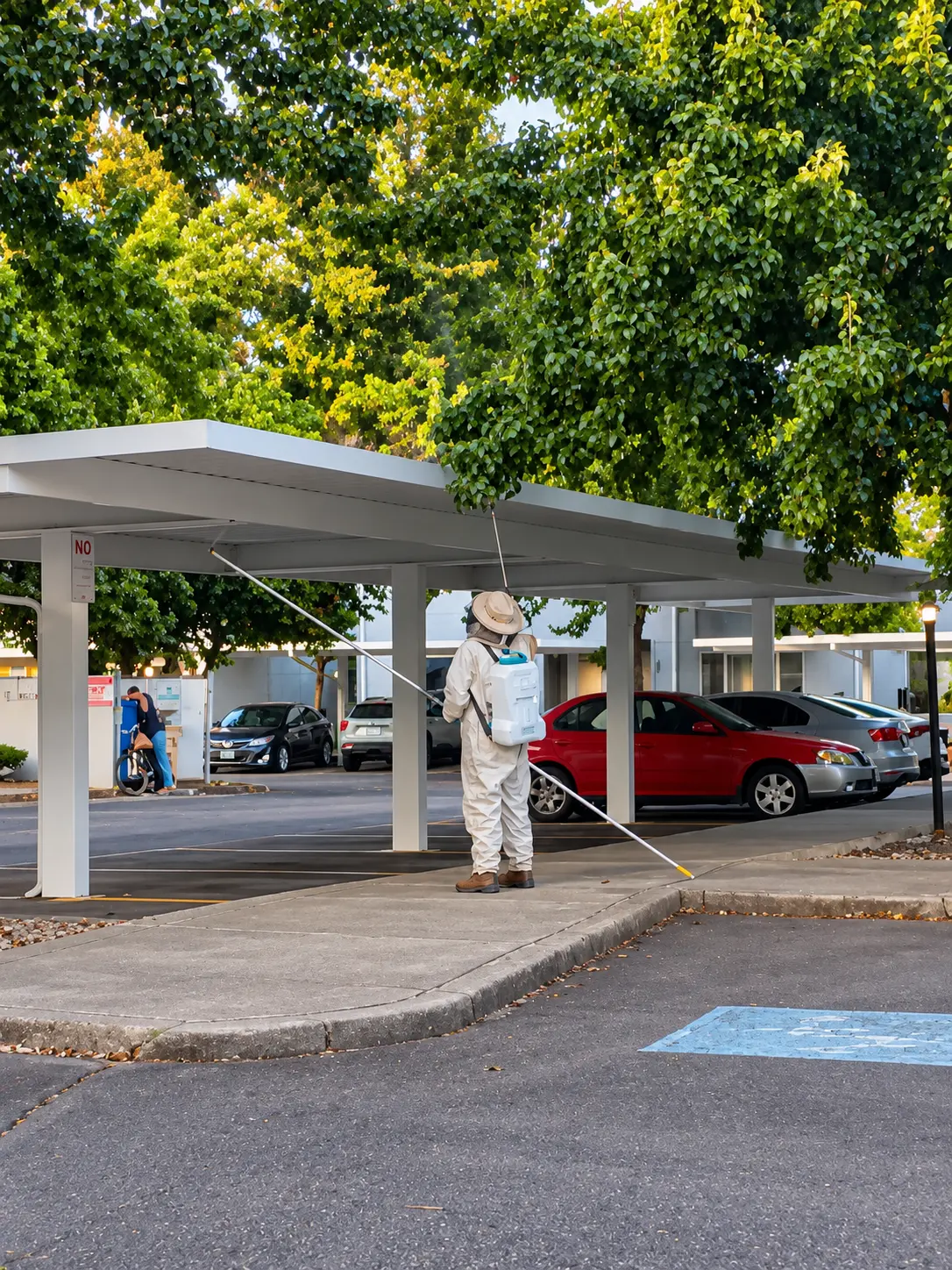
Treating a nest site along a carport eave, exactly the kind of overhead, hard-to-reach spot a DIY spray rarely finishes the job on.
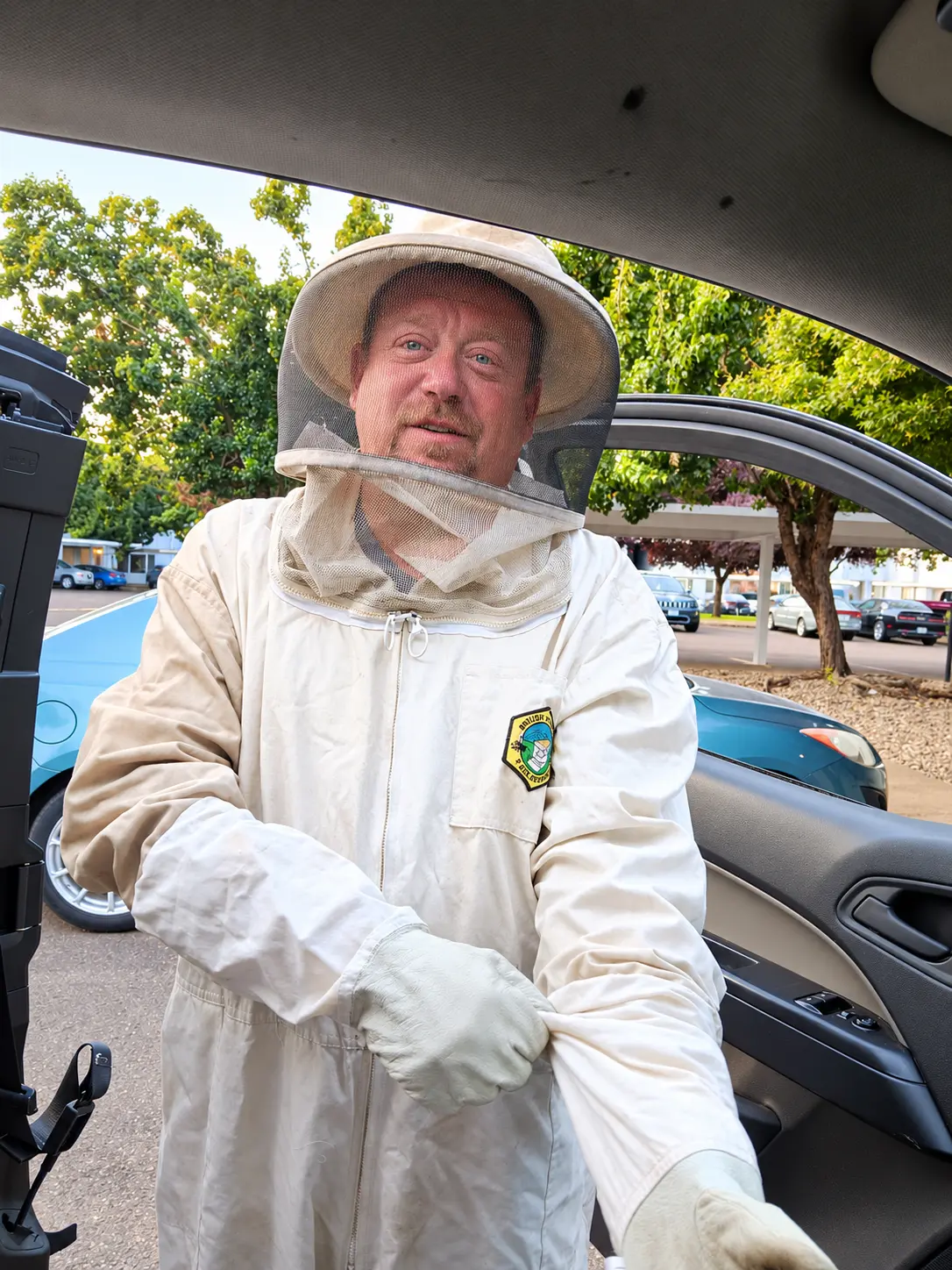
Full protective gear for an active colony. Not optional once yellow jackets are defending a nest.
Pro versus DIY
Why timing and nest location matter more than the product
The whole colony is home at the wrong hours
Foraging wasps are out during the warm daylight hours. The colony is most contained and least active in cool, low-light conditions: before roughly 7 to 10 AM or after dark. Treating in the middle of a warm afternoon provokes an active, airborne colony instead of a sluggish, contained one.
Underground and wall-void nests are the real hazard
Yellow jackets inside a wall cavity or an underground burrow are invisible until disturbed. A DIY spray aimed at a visible entrance hole does not reach the nest the way it would with an exposed paper-wasp nest. That is the specific scenario where professional equipment and technique matter most, so describe the location when you call, not just the insect.
The sting risk is not theoretical
Insect sting allergy affects an estimated 1.6% to 5.1% of the US population with a history of life-threatening reaction. Anyone who has already had one allergic sting reaction has about a 60% chance of an equal or worse reaction if stung again.
- SourceFamily Handyman: When Is the Best Time to Spray a Wasp Nest?Trade-source consensus on nest-removal timing.
- SourceAmerican College of Allergy, Asthma & Immunology: Insect Sting Allergies
Figures worth knowing
Numbers on this page come from somewhere, and it says where
Late Aug–Sep
When colonies peak
Colonies grow all summer and are at their largest, most food-stressed and most defensive immediately before the fall decline.
OSU Extension: Understanding Yellow Jackets and Other Wasps60%
Chance of a repeat reaction
Someone who has had one allergic sting reaction has roughly a 60% chance of an equal or worse reaction if stung again. Potentially life-threatening reactions occur in 0.4%–0.8% of children and about 3% of adults.
American College of Allergy, Asthma & Immunology: Insect Sting Allergies72
US deaths per year from stings
An average of 72 deaths per year in the United States are attributed to hornet, wasp and bee stings.
CDC National Center for Health Statistics: sting mortality (July 2023)
Cost
What a wasp job costs
Nest removal is priced by the job, and published Oregon figures for it are scarce, so this page does not quote a range. The Oregon general pest control figures elsewhere on this site are for recurring service, priced on a different basis, and do not apply to nest removal.
- Depends on nest location and access
- Oregon wasp / yellow jacket removalPriced per job: ask on the call
What does move the number, consistently across the category: whether the nest is exposed or inside a void or underground, how high and how accessible it is, the species, and how active the colony is at the time of the visit. Those are the things worth describing on the phone.
Misconceptions
Three things people believe that cost them money
“It is just a hornet’s nest, I can knock it down myself.”
Species and location change the problem entirely. An underground yellow jacket nest or a hidden wall-void colony is a fundamentally different and more dangerous removal than a visible paper-wasp nest under an eave.
University of Florida IFAS Extension: hornet vs. yellow jacket“Once it is cold, the nest is dead, so there is nothing to worry about.”
True for that specific colony, since OSU confirms only mated queens overwinter, but not a guarantee against a new nest nearby the following spring from an overwintering queen.
OSU Extension: Understanding Yellow Jackets and Other Wasps“They will come back to the same nest next year.”
They will not. Per OSU, each colony builds a brand-new nest rather than reusing an old one. A new queen can, however, start one nearby.
OSU Extension: Understanding Yellow Jackets and Other Wasps
Before you book
Good to know before you call
A few practical points worth knowing before you pick up the phone. If anything here does not answer your question, call (503) 269-7812 and ask.
Good to know
Scheduling a visit
Call (503) 269-7812, Monday to Friday, 8:00am to 6:00pm. Describe the pest, where you are seeing it and which town you are in, and you will get a straight answer on the next available visit. For an active wasp or yellow jacket nest, call rather than using the online form.
Questions
What people ask about wasps & yellow jackets
9 answers, written the way someone actually asks the question, of us or of an AI assistant. Each one stands on its own, and each carries its source where it makes a factual claim. Anything not covered here is a quick question on the phone.
It matters a great deal, because it changes where the nest is. Yellow jackets are the smallest at about 1/2 inch, sharply black and yellow, and they nest underground or inside wall and structural voids. Paper wasps have slender bodies, are muted brown or reddish, build small open umbrella-shaped nests, and are the least aggressive of the three. Hornets are the largest, build large aboveground paper nests, and are the most aggressive when a nest is disturbed.
Per Oregon State University Extension research, yellow jacket populations in the Pacific Northwest peak in late summer, with stinging-insect activity and aggression rising through July as colonies grow and food sources become scarce. Activity can remain aggressive into fall as colonies begin to decline, even as cooler weather sets in. A nest is often most dangerous to remove without a professional right when it is largest.
This is the hardest version of the problem. Yellow jackets nesting in a wall cavity or an underground burrow are invisible until disturbed, and a spray at the entrance hole does not reach the nest. If you are seeing a steady stream of insects going in and out of a single point in the siding, a soffit, or a hole in the lawn, describe exactly that when you call. The location changes the approach more than the species does.
- SourceUniversity of Florida IFAS Extension: hornet vs. yellow jacket
- SourceFamily Handyman: When Is the Best Time to Spray a Wasp Nest?Trade-source consensus on nest-removal timing.
No, not to the same nest. OSU Extension records that only new, mated queens survive the winter (the rest of the colony dies with the first hard freeze), and each colony builds a brand-new nest the following year rather than reusing an old one. An overwintering queen can, however, start a new nest nearby the following spring, which is why the area is worth watching in early summer.
In the cool, low-light hours, before roughly 7 to 10 AM or after dark, because that is when the whole colony is home and least active. Foraging wasps are out during the warm daytime hours, so treating mid-afternoon risks provoking an active, airborne colony rather than a sluggish, contained one. Timing matters more than product choice here.
- SourceFamily Handyman: When Is the Best Time to Spray a Wasp Nest?Trade-source consensus on nest-removal timing.
For most people a sting is painful rather than dangerous, but the tail risk is real. Insect sting allergy affects an estimated 1.6% to 5.1% of the US population with a history of life-threatening reaction. Someone who has already had one allergic sting reaction has roughly a 60% chance of an equal or worse reaction if stung again. An average of 72 deaths a year in the US are attributed to hornet, wasp and bee stings.
It depends entirely on what and where it is, and that is the problem: most people decide before they know. A small, visible paper-wasp umbrella nest under an eave is a different proposition from an underground yellow jacket colony or one inside a wall void, which cannot be reached from the outside and will defend an entrance aggressively. Late summer, when colonies are largest and most defensive, is also when most people try it themselves.
Nest removal is priced by the job, so this site does not quote a single figure, and the Oregon general pest control figures quoted elsewhere are for recurring service on a different basis. What moves the price is whether the nest is exposed or hidden in a void or underground, how accessible it is, the species, and how active the colony is. Call (503) 269-7812 and describe those.
Call (503) 269-7812, Monday to Friday, 8:00am to 6:00pm, and say where the nest is and how close it is to a door, walkway or play area. Timing depends on the schedule that week, and you will get a straight answer on the next available visit. Until then, keep people and pets away from the entrance and do not disturb it.
The other four
Everything else Cherry City treats
- ResidentialGeneral Pest ControlOngoing pest prevention and treatment for common household pests in the Salem area.Service page
- ResidentialRodent ControlIdentification, exclusion and removal of mice and rats from homes and outbuildings.Service page
- ResidentialAnt ExterminationTreatment and prevention for ant infestations, starting with identifying the species and the nest.Service page
- CommercialCommercial Pest ControlPest management service plans for businesses across the Salem area.Service page
Get it handled
Active nest near a door or a play area?
Say where it is (eave, siding, ground, wall void) and how much traffic you are seeing. Location decides the approach.
- Address
- Cherry City Pest Control
115 Kashmir St SE, Salem, OR 97306
Get directions - Hours & reputation
- Monday to Friday, 8:00am – 6:00pm
Closed Saturday and Sunday
4.9 stars on Google